The Personal Universal - on jazz as the tradition of unique sound production

On Uniqueness
Language, in its purest sense, constitutes the use of symbols to transmit information between minds. The accuracy of this transmission depends largely on the degree of shared definitions of said symbols - be it a conversation between 2 people, or a single person broadcasting to millions. In a world where we see a curious trend of language devolving to blur the lines between the literal and figurative (for example, it is now common to hear the word literally used to mean, literally, not-literally), it is important to clarify what we mean by the foundational term of this essay - the word unique.
The root un carries a mathematical precision that place the word in a rare class, whose definition is beyond a shadow of a doubt. That being - of ALL instances of a class of a thing, only ONE. Contrary to popular misuse of the word - one’s funky blue shirt or newly designed car is not really one of a kind. However, the way a person perceives color, hears sound, and experiences the fundamental units of experience via the five senses as processed through the mind, most certainly is individual. Understanding this, we can know that every human being is, by nature, unique.
To dig deeper, let us contemplate the reciprocal, if not perplexing, relationship between mind and experience. All experience is filtered to our senses via the mind, while the quality of the mind is simultaneously shaped by everything we experience. In particular, the conditions and circumstances of our early years serve to shape the fundamental units of our conscious experience - how we experience happiness, and how we feel about ourselves, and most importantly, our capacity for love. When we consider that no other being has exactly the same set of life experiences, ancestral lineage, or sociocultural programming at a given point in space and time, it is clear that the quality and programs of one’s mind are unique. Ergo, when dealing with music, we can know that each musician has a unique relationship to sound.
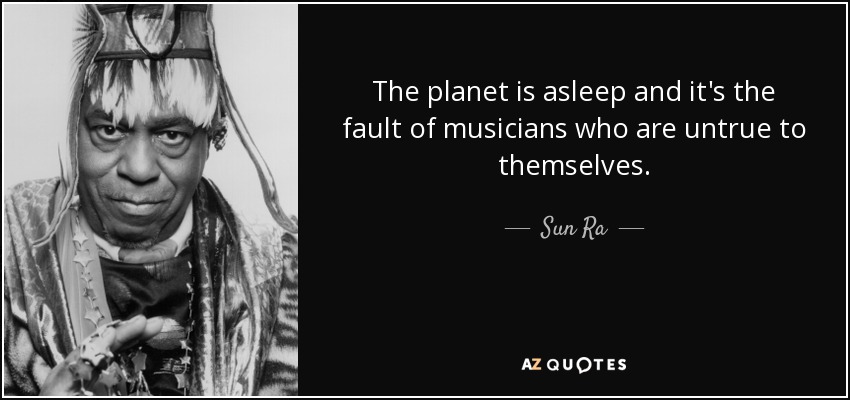
When we examine this connection closely, we see implications far beyond the proverbial bandstand. In fact, the relationship of the individual to sound is a deeply revealing microcosm of the state of our world. Consider the Sun Ra quote: “The planet is asleep, and it’s the fault of musicians not being true to themselves”. If we think of humanity not as a collection of individuals, but as an organism consisting of billions of unique yet interconnected human beings - it stands that, like any organism, it can only function properly when each individual is able to carry out the unique function of which only they are capable. For the musician, this function is rooted in one’s relationship to sound, and the jazz tradition is essentially an esoteric science for the development and expression of this relationship.
Sun Ra is as qualified an elder as we have in the tradition of jazz. Often miscategorized as an “out” musician, Sun Ra actually resides at the centerpoint of the tradition. His music is a cellular-level integration of all styles throughout the history of the music - including but not limited to be-bop, traditional music of Africa and the diaspora, electronic music and the avant garde. Due to its nature as a framework for the esoteric development of unique musical expression - jazz in its largest sense has proven to be something greater than any set of stylistic rules. It is akin to a soil in which any musical seeds can be planted and allowed to grow, imbued with this spirit of one’s individual truth. Sun Ra’s life is,itself, a work of and he is a shining example of the principles we are discussing. His words are to be taken seriously, and literally.
Musical processes as guided by the compass of individuality
Technical Mastery
The term mastery is often thought to certify one’s achievement of a high level of technical ability. For the purposes of this writing, mastery is defined as the dedication of one’s life to the endless work of discovering the optimal means of personal expression by means of a particular skill. While a great deal of technical and musical knowledge is indeed necessary to make this dedication, mastery is really a beginning, a doorway to a lifestyle, not a point of achievement.
Mastery of one’s instrument, and the principles of music beyond one’s instrument, are necessary foundations for the jazz musician. If our purpose is to develop a means of expression rooted in our individuality, we must have the ability to express all of the subtleties and complexities of our physical, mental and spiritual existence. All musical systems contain keys to unlock countless means of expression. The work of the jazz musician is to spend a lifetime studying the system(s) they resonate with, absorbing and transforming the information into self knowledge. Ultimately, this leads to the creation and development of one’s own musical system.
The work is necessarily endless - as we evolve within our environment, the means of expression must also evolve. Sincere, personal expression cannot remain identical from moment to moment, let alone year to year. Make no mistake, a fundamental consistency of tone and stylistic elements over the course of one’s lifetime are indeed a mark of having discovered and refined one’s personal sound. The subtleties and context of that expression, however, require a moment to moment honesty of interpretation, something that is only possible when one is able to embody the middle path between humility and confidence. In the words of another master, Ornette Coleman, “Jazz is the only music in which the same note can be played night after night but differently each time”
Composition and improvisation - keys to the inner world
In the spirit of the tradition of radical self-realization music, composition may be defined as a set of instructions, determined by a musician, to reveal a musical cosmos discovered in their inner world. On the other hand improvisation can be defined as spontaneous musical expression without pre-determined instruction. In either case, the quality of the music produced increases in relation to its clear mirroring of the artist’s true self. These two concepts sit at opposite ends of a spectrum. In reality, almost all music is plotted somewhere along this line, utilizing both concepts to different degrees.
The great drummer, composer and multi-instrumentalist, Ronald Shannon Jackson, used to advise musicians to pay close attention to what they played in the first moments that they sat alone with their instrument. In my experience, these moments are indeed a sacred time where personal gestures are revealed. In those first moments, there is a purity of mind, no-thought as it were, where one just plays from oneself without thinking. In the moments after, it is only natural that mental currents related to things such as practice agendas, upcoming concerts, perceived social standing, and all sorts of egoic concerns, begin to surface. These thought patterns can be valid in a sense, and it is important to deal with them in a disciplined way. Still, the personal space from where our unique relationship to sound is discovered is hidden behind the veil of ego. The ability to enter and protect this inner space is a skill of utmost importance, and must be refined by one on the path of mastery. The gestures discovered in this space are no less than sacred pieces of self knowledge to be studied and developed as necessary elements to service the offering of one’s unique expression.
III. Individuality as foundation for interpersonality - foundational communal circuits
As we have demonstrated, the practice of detachment from the limited/ego self is a prerequisite to access the deepest reaches of our inner world. From this practice, we open to our true selves - free of social, familial and cultural programming. Then and only then can we explore our unique relationship to sound. In the jazz environment, collaborators and audience act as mirrors through which the unique expression we are crafting is reflected, so that it may be refined, improved and adapted to specific environments.
We must stress, in the greatest possible terms, the focus on the individual’s unique relationship to sound. Still, in reality, it is only half the path to meaningful expression. In almost all cases, artistry is most useful when it creates connections between people. There may be rare cases of masters who are satisfied with the development of their expression in, of and for themselves, but they are the exception that proves the rule. The highest function of the jazz musician is to transform their personal truth into a universal truth, an event which occurs as a direct transmission of one’s unique expression to another, such that this idea can root itself and grow in another person, aiding in the development of their own truth.
In the jazz tradition, there are three foundational communal circuits that are the primary relationships where this transformational experience occurs:
Mentor/Discipleship - A sincere heart to heart connection in which an elder can recognize and guide a younger musician through the processes of musical self realization. In turn, the mentor grows from watching the unique ways in which the student digests and expresses these concepts.
Ensemble playing - The subtle ways in which other musicians adjust, interpret and execute specific elements of a composition reveal how it actually works and what its function is.
Performer/Audience - A gathering of individuals playing and listening from the heart/true self creates a powerful connection based on the commonalities of our personal experience - one that is, literally, beyond words. A profound, real time connection over a shared love of particular vibrations. The social element of the music is deeper than providing entertainment. It has the potential to create a connection between composers, performers, and audience members all realizing each other’s uniqueness through the prism of their own truth.
Others act as mirrors through which the unique expression we are crafting is reflected, so that it may be refined, improved and adapted to specific environments. All of the knowledge we gain through our contemplation and practice becomes useful when it is applied in real situations with other people. Listeners and collaborators create different environmental conditions to which a musician is forced to adapt, and thus evolve, their concept.
IV. The necessary foundation of egolessness
Damo Mitchell, teacher of eastern wisdom traditions, offers a beautiful interpretation of the Daoist principle Wu Wei, that provides illumination for our study. Often translated as “non doing” or “effortless action”, Mitchell posits that a better translation is simply, “attention”.
Consider a concept of attention vs intention - intention being a purposeful action, and attention being simply, awareness. The best improvisation exists at the meeting point of these two, but in most cases we tend to stress the development of attention, since most of our experience in the external world programs us towards a constant state of intention. With this in mind, we can say that improvisation requires sitting in a balanced state of giving one’s expression with uncompromised sincerity, while simultaneously receiving the reaction of collaborators and listeners, and responding accordingly.
The ability to simultaneously hold these states of giving and receiving is proportional to the degree of one’s detachment from ego. Egolessness is humility, which is a state of openness. Egocentricity is arrogance, a state of closure. Only in a state of humility can we hear and respond to things as we truly are. In the opposite state, we become concerned with what others think, concepts of what and who we should be. This is where the disruptive, inverted egocentric tendencies such as self doubt surface in the mind. This state, driven by the survival of the ego, seeks to dominate our mental activity. Allowing this state to dissolve, we exist as we truly are, and thus can receive from and give to what is happening around us.
The ego is where the programming that we receive from family, society and culture lies. This programming more often than not serves the function of hiding our uniqueness behind a veil of concepts and identities that were placed in us from outside of us. By detaching from all of this, our true self imbues the music with the magic that only we can give it.
V. Transmutation of the personal to the universal
Ultimately, the highest function of this music lies in the process of a personal truth becoming universal truth. When one’s uniqueness is flowing, it creates a powerful resonance that will provoke all sorts of reactions. While the sound is unique to that individual, we all experience life from the endless pool of subtle ideas and experience. While never exactly the same, the reality of one producing something that allows others to experience beauty, is an affirmation of the existence of love in and of itself. This process exemplifies the divine creativity spoken of in the bible (In the beginning was the word…) and all sacred traditions - it produces love, humanity, and life itself. As such, it is the highest function available in any relationship, and certainly in music.